

Founder Babies
A seldom discussed mode of operations at startups.

On September 2024, Paul Graham released the essay Founder Mode which was received to a raucous audience over on the ThreadstwitterXsphere.
For some reason, the very people who felt pressured to look to professional management and had no issue mining the Stanford MBA mines in Palo Alto until IPO until these very people felt fit to “take back” their companies.
As such, many of the “taking back” meant that many rules of decorum that were established were thrown out of the window as it’s seen as such decorum prevents you from implementing your will at a company.
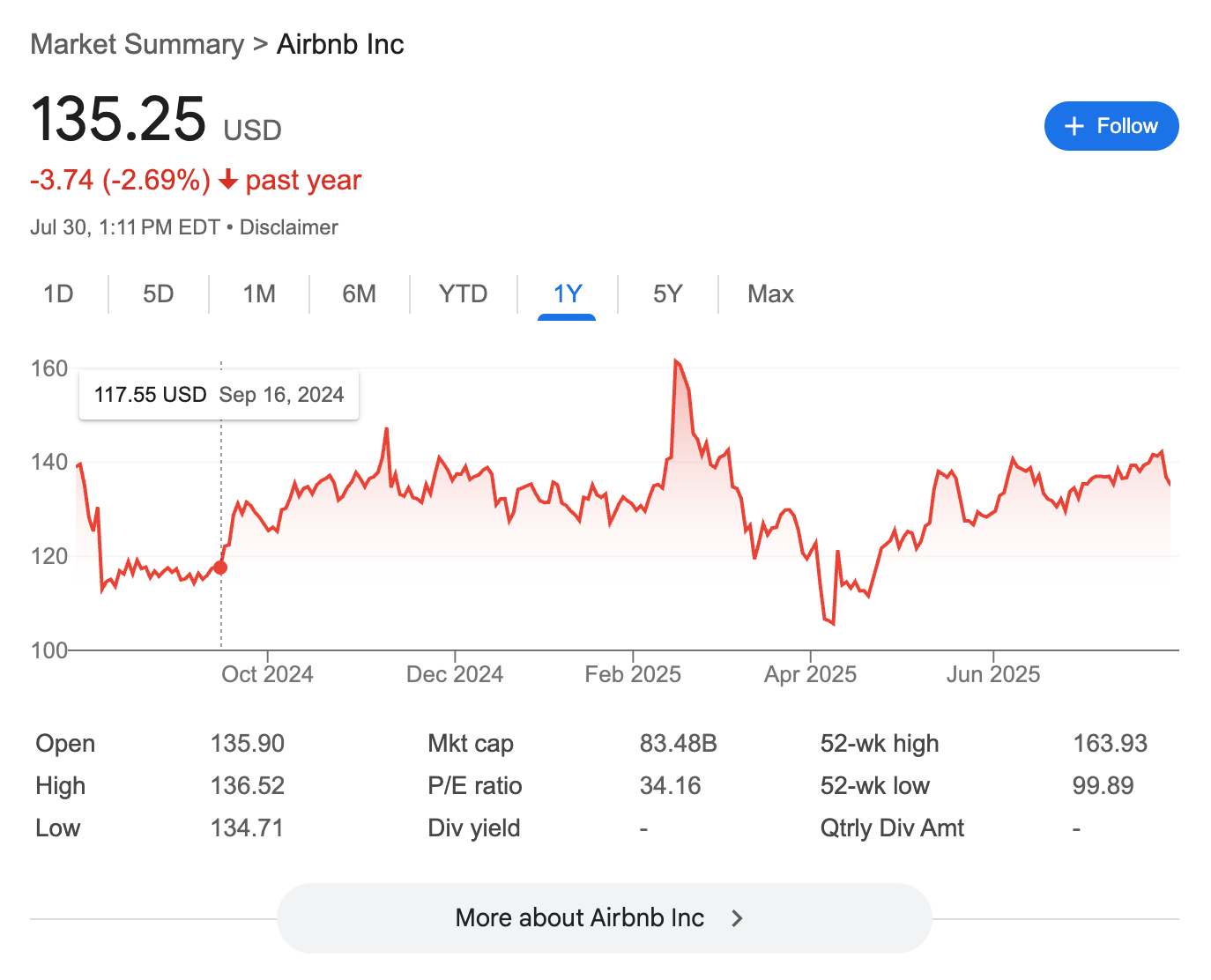
At the time of writing, Airbnb has only traded sideways since the release of that essay.
Now I won’t attribute a single essay to the lack of performance of a company, but I note this because there is this prevailing false belief that if you could be as much as a micromanager that Steve Jobs was, you’d suddenly achieve greatness.
Maybe! That may possibly be well true.
In my opinion, the Founder Mode essay and the new crop of GenA/Young Zoomer wave has gave permission to founders to no longer emotionally regulate themselves, while ignoring the lessons of history. If one believes, such as I do, that new businesses are essential to driving innovation, then I see start up founders as the lifeblood of this talent pool. We need more of them, and we need them to be of a higher quality.
Many of these founders are good friends of mine— so when it was time to write about this topic, I waffled repeatedly on the topic out of fear of offending them. Much of them are fantastic product builders… but when it comes to hire employee #1, the wheels come off. Prior recommendations made to them to hire good friends of mine would lead to a burned bridge, the founder not knowing how to work with someone who is not them leading to their first or second hurdle.
Despite the fact that you need such rambunctiousness to get started to eschew stable W-2 income. I never met a founder without an ego large enough to carry them forward, but that same sword cuts them. Such emotional immaturity leads to tantrums and introduces a preventable structural brittleness to the companies at the very start.
In short, I am discouraged by the general lack of emotional maturity of this current crop of early stage founders. I don’t blame them entirely, founding a company is a grueling decathlon that requires an amazing amount of mental fortitude.
In this essay, I will walk through what does it mean to be a “Founder baby”, why is it so, and the nature of responsibility you have when you start a company, and a new mental model you can use if you find yourself in this trap the way anyone can be.
If you have a story akin to this, as a leader or as a early employee- if you’re willing to share, I am willing to hear it. Comments or you can email me directly at email [at] ngelo [dot] xyz
A Company is Born
When you start a company, usually, it comes out of a place of annoyance. One might think: “I have used everything out there, and nothing allows me to truly do what I want to do.” Could be software, could be a service like a print shop… however, there is some sort of catalyst where it would lead a founding team to either sit down and decide to say “Enough.” and work on something new.
(With the exception of a incubated company whose origin is one of a slime mold grown in a petri dish, I am looking at you Sutter Hill Ventures.)
A founder’s neurosis is maybe the most precious aspect because in a sea of indifference to a problem, that care and hyper focus has birthed billions… no trillions of dollars in value. That is not hyperbole.
Let’s assume for this exercise that you had enough.
If you are lucky, then that neurosis will resonate with an audience as a latent group of people who were wondering if someone was actually going to do something about the problem finally found someone who did. They give you money and your company is on it’s way to becoming a: thing.
The skillset to make products and the skillset to growing a company unfortunately are nearly two separate circles without a lot of overlap on the Venn diagram. You decide to contract out the work to see if you can get help. You contract a designer and a developer to help you out on the project. Now, you have to write specs after not having to for the first 9 months since you’ve been able to hold the whole product in your head. The contractor doesn’t seem to get it after you explain over Slack two different times. You start to spend more and more time in alignment meetings. You’re thinking of hiring since the contractors aren’t “getting it”.
You’re frustrated.
You pull the trigger on a founding engineer hire that you got for a good comp package for 1 percent and 120K yearly salary. They hail from Google, so they are very peculiarly specific about the amount of tooling they need to get the repo going on your machine. They decide to spend two weeks on working on code quality instead of features.
It’s evidently clear you are not on the same page.
Two months go by, you went from ramen profitability to slightly under as you are prioritizing growth. The seed checks finally hit the bank account but you’re still dealing with alignment issues with the team. In your first tantrum, you decide to fire off your first all caps message to the founding engineer on Slack.
It works.
He’s shipping like never before. He’s staying over the office until 4 AM.
You grow the team to 5.
In your search for “cracked” engineers, you found people are willing to run through walls for the company. However, you notice that a competitor is going to launch something soon and you want to get ahead of it, you demand the team drop everything they are working on and add the new feature. You get the feature out. Elation. What’s another feature right? You add scope for something you think is game changing. The team pulls through but you feel the morale slip.
Doesn’t matter. Step on the gas.
Smiles turn to indifference. You’re angry. Now it seems like no one here cares the way you do. In the next all hands, you dress down the team. Mixed bag. Some people respond with more hours, some disconnect. Whispers then go around the office from new hires to the people who’ve been around a bit.
“Are they always like this?” You overhear.
…
The biggest challenge for many founders who start a company out of passion is that the same toolset that they may apply to themselves then start to breakdown. Something not working? Work harder. When that toolset breaks, then they open up the classical book of the Jack Welch style of management: fear.
One can look to the effectiveness and the depravity of Soviet Army and the Warsaw Bloc to know that fear does indeed work. However, I wouldn’t say that there is a popular group of people clamoring to be part of that system.
The main issue is that much like a growing child, the vocabulary for the person who is now thrusted in a leadership position doesn’t have the ability to communicate the issues that they see. Often times, these issues fester until they become acute. We *know* that this behavior is wrong, but due to the pressures and misunderstandings of the usual founding lifestyle, and the lack of sleep that often results… it usually manifests into a tantrum.
This is what I call: Founder Baby Mode.
Add to what is popular perception of what management should look like, which is usually yelling. It compounds.
The traditional reaction as a company scales is to then add layers of management between the “unreasonable” founder and the employees. This then dulls the effectiveness of the company. This is one the reasons why I dislike PG’s essay because it assumes a strict binary between a company’s operating effectiveness and the vision of the founding team.
You can have involved leadership who gets down to brass tacks while building a strong sense of cohesion.
Growing Up
The transition from solo founder to team leader is one of the most jarring career shifts imaginable, yet we treat it as it’s intuitive. (Or there is this belief that people are just naturally born to lead, another general gripe I have.)
So what happens next?
A company can be in this mode for quite some time until the founding team learns on how to scale themselves and overcome a number of emotional plateaus that take their high taste bar for the product, into a high taste bar for the company.
Example: I have a friend of a high grossing app on the App Store who had to churn through a few hires.
"I don't understand," he said. "I'm not asking for anything unreasonable. I just want people who care as much as I do."
"…care as much as I do" is a dead giveaway for Founder Baby Mode. It sounds reasonable on the surface, but after a discussion, he was looking for "I want people who will absorb my anxiety and panic the same way I do."
Which is fair!
When you are spending your golden opportunity years, especially if you are a young founder from the ages of 20 to 30 while you are watching your peers graduate, start families, and travel the world… that level of resentment builds into how you make decisions for your company. It is paramount that you let those things not influence how you treat the people that you desire to bring onto this journey.
Your employees didn't sign up for that. They signed up to solve interesting problems, work with smart people, and maybe get rich if things go well.
But caring and panicking aren't the same thing. Some of the best employees I've seen are the ones who care deeply about the work but don't get swept up in emotional weather patterns. They're the ones who say "yes, this is important, and here's how we're going to solve it" instead of "oh my god everything is on fire." (Something that I have witnessed first hand at Railway, when we make a great hire, they bend the arc of the company.)
The really insidious thing about Founder Baby Mode is that it can work in the short term. Fear is a hell of a motivator. People will work harder, longer, with more intensity when they're afraid of your reaction. You might even ship faster, too.
Athletes, not Children
However, there are founders who manage to avoid this trap entirely.
They maintain urgency and high standards without turning into emotional terrorists. I think about the founders I respect most— they tend to be people who can be incredibly demanding about the work while being fundamentally kind to the people doing the work. These are usually the founders that I like working with the most.
This essay is a bit short on solutions versus calling out a pattern that I am seeing however, I am biased due to my workplace.
At Railway, I do enjoy working closely with our founder and CEO because over the last 4 years, I have seen them grow as a leader. (As well as the people who I call friends who have gone on to start companies.)
They were able to keep the neurosis at bay while also creating an environment for urgency that matches the pace that a company needs to stay alive. That neurosis on how the Cloud should be versus the status quo is why we have 1.5 million users and counting.
Instead of pressing the fear button, we usually try our best to create a system where everyone has shared contexts so we have good answers to: “Is this problem going to get solved?” Usually the toolset we have used was:
Sharing all financial metrics to get everyone on the same page if the company is alive/dead.
Having systems in place where people demo and are encouraged to ship their work as soon as possible.
Being kind, not nice, when giving feedback on anything company strategy related. Using RFC documents to farm dissent.
And the team has learned to use our own emotional state as data. When we feel ourselves getting frustrated or impatient, instead of taking it out on each other, we steps back and asks: "What's the underlying problem here? Sometimes it's a process issue. Sometimes it's a communication breakdown.
The transition the founder should feel then is that they should see themselves as more of a coach vs. a star athlete.
The transition from athlete to coach is brutal for a lot of people, which is why you see so many great players become terrible managers.
Michael Jordan was arguably the greatest basketball player ever, but his brief stint as an executive with the Wizards was... not great. He couldn't understand why other players couldn't just "be like Mike." He expected everyone to have his level of obsession, his tolerance for pain, his willingness to sacrifice everything for winning. (…and he made out well for that deal.)
But then you have someone like Steve Kerr. Good player, not a superstar. But as a coach, he figured out how to get a team full of superstars to play together. He understood that his job wasn't to be the best player on the court, it was to create conditions where the best players could be even better.
It's not about having less ego, I, in fact like the presence of ego.
But instead of "I need to be the best developer in the room," it becomes "I need to build the smartest team in the room." Instead of "I need to solve every problem," it becomes "I need to create an environment where problems get solved."
…or a new rallying cry for your company: “We need to build the best damn product out there.”
Completely resonate with this.
I don't quite like how founder mode became the goto justification for some of the worst aspects of "efficiency" changes made by big companies like msft / meta / amazon.
Also in my experience, I see people believing that founder mode means that you cannot trust people working on things, because they will never care as much as you do, which is so counter intuitive to the expectations from a leader.